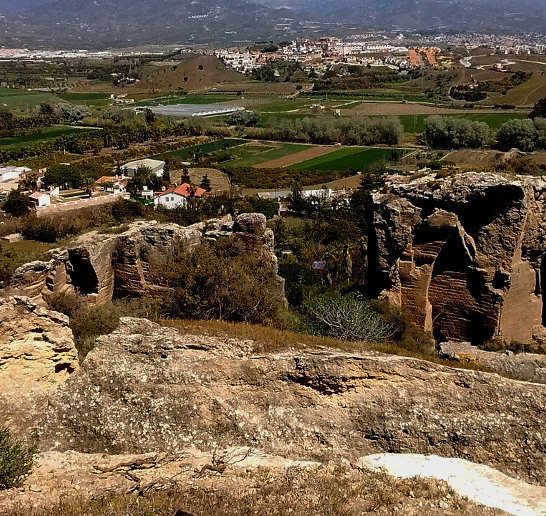
About Toscanos
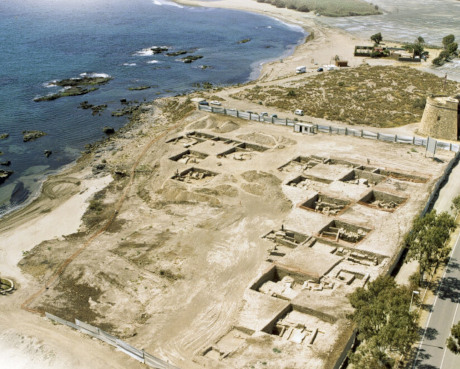
Discovered in 1961, Toscanos is the largest, best-documented, and most architecturally sophisticated Phoenician site on Spain’s southern coast. The prosperous urban settlement was founded in the mid-eighth century BC and abandoned around 550 BC, when the population moved to nearby Cerro del Mar.
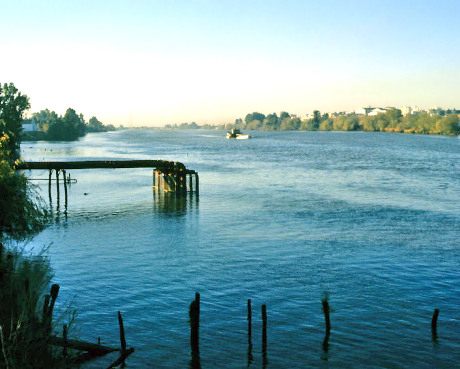
This was a period of intense trade with the local population. Toscanos shares many features with other regional Phoenician sites, including its location on a promontory dominating the mouth of the Vélez River. This strategic position linked the Mediterranean to the Andalusian interior and its indigenous communities.
Toscanos sat near other Phoenician settlements, particularly Morro de Mezquitilla, just seven kilometres away. This proximity suggests mutual cooperation and interdependence. These settlements shared natural harbors within the same wide bay, with their necropolises separated from the urban areas by rivers.
Excavation work at Toscanos by the German Archaeological Institute began in 1964 and continued until the 1980s, gradually revealing more of the site’s urban design. The first settlers built a small number of large, rectangular buildings connected by streets and paths, with a defensive ditch also added during this early stage. The most impressive construction was an elite, 110-m² residence with seven rooms built around a central courtyard - evidence of the high social status of the first Phoenicians to arrive in Toscanos.
Within 30 years of its foundation, Toscanos was dramatically expanded, reorganised, and upgraded, apparently in response to its growing economic success, with the residential and commercial districts in the centre of the settlement clearly separated.
Around 700 BC, a monumental 165-m² warehouse was built in the centre of Toscanos. It consisted of three wings and at least two floors, providing a storage capacity that far exceeded the local inhabitants' needs. Excavators discovered the remains of numerous transport and storage containers for merchandise - including preserved meats, fish, grain, oil, and wine - underscoring the warehouse’s vital role in regional trade.
The commercial importance of Toscanos is evident from the size and central location of the warehouse, which became the main focus of the settlement during the seventh century BC. Small, simple dwellings were constructed around it, probably to accommodate personnel or serve as administrative spaces.
Around the same time the warehouse was built, a harbor complex was constructed with facilities for docking and handling cargo. From circa 650 BC, the settlement expanded to include the neighboring hills of Cerro del Alarcón and Cerro del Peñón.
A large, isolated rectangular building with walls over a meter thick was erected on the summit of Cerro del Alarcón, likely serving as a military outpost within the outer fortifications. Shortly afterward, a defensive wall was constructed to enclose and protect the entire Toscanos site. This fortification was built either in response to an external threat or simply to secure the warehouse and the expanded settlement.
The Cerro del Peñón hill was used exclusively as an industrial quarter and metalworking district. Excavators unearthed a smelting furnace, bellows, tuyeres (pipes), and considerable amounts of slag, revealing workshops engaged in iron and copper processing. Beyond metallurgy, the local economy included purple dye and cloth production, fishing, shellfishing, and livestock husbandry for meat, milk, traction, and exchange.
Interestingly, Cerro del Peñón may have initially served as a cemetery for the first settlers. The discovery of a bronze incense burner (thymiaterion) and a fragment of an alabaster urn indicates that early burials took place on the hill.
Directly across the Vélez River from Toscanos lies Cerro del Mar, the settlement's main necropolis. Excavations at the nearby Casa de la Viña site revealed characteristic Phoenician grave goods, including mushroom-lip jugs and trefoil (three-spouted) mouth pitchers. The site also featured shaft tombs and alabaster urns containing cremated remains and perfume residue. When Toscanos was abandoned around 550 BC, the population did not disappear; instead, they simply moved across the river to establish a new settlement at Cerro del Mar.
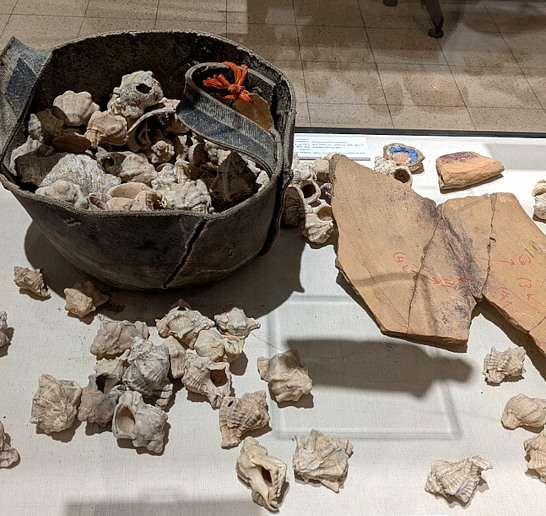
Murex snail shells from the 10th-7th centuries BC with remains of Tyrian purple dye on the pottery shards.
The Purple People
The famous purple dye extracted from murex sea snail glands was the source of both the word "Phoenician" (derived from the Greek for "purple people") and the civilization's immense wealth. Traded throughout the Mediterranean, this luxurious dye was so highly prized that it often cost up to 20 times its equivalent weight in gold.
According to legend, the god Melqart accidentally discovered "Tyrian purple" while trying to win the heart of a beautiful sea nymph. Following this mythical origin, purple fabrics became a luxury associated across various cultures with royalty, nobility, and the priesthood.
Production was incredibly labor-intensive; it required 12,000 sea snails to extract just 1.5 grams (0.05 ounces) of the intense dye. This tiny yield was only enough to color the trim of a single garment. Because the unique dye deepened in color rather than faded over time, purple clothing became the ultimate symbol of social status, wealth, and power.
Given the labor-intensive manufacturing process, demand for Tyrian purple fabrics soon outstripped supply. As the local Murex snail populations in the Phoenician homeland became decimated, traders looked further afield. Evidence of this expansion is found across southern Iberia, where extensive deposits of crushed Murex shells have been excavated at sites like Toscanos, Morro de Mezquitilla, and Almuñécar (Sexi).
Address
Opening Hours
Tues-Sat: 9am–9pm
Sun & holidays: 9am–3pm
Mon: Closed
Free admission for EU citizens and Spanish residents. Other visitors: €1.50.
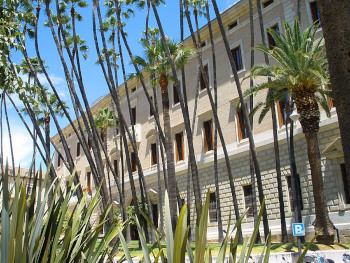
The Museum of Malaga is located in the Palacio de la Aduana (Customs Palace) next to the hill of the Alcazaba in the centre of the city. The imposing neoclassical building was built in 1791 and became Malaga’s main museum in 1973, before undergoing refurbishment from 2008 until its reopening in 2016.
The museum brings together the collections of the former Provincial Museum of Fine Arts and the Provincial Archaeological Museum, and is divided into two sections, with more than 2,000 fine arts pieces and 15,000 in the archaeology collection making it the largest museum in Andalucia and the fifth largest in Spain.
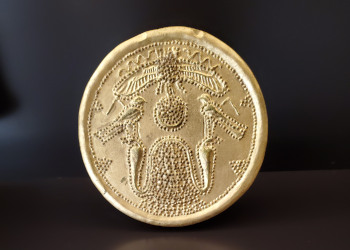
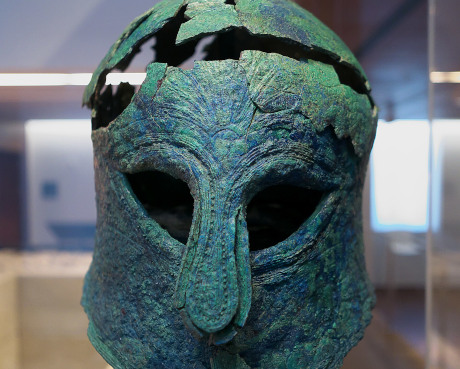
One room is dedicated to the discoveries made since 1964 at the Phoenician sites of Toscanos, Trayamar, Morro de Mezquitilla, Jardín and Chorreras by the German Archaeological Institute. Highlights include the Trayamar Medallion (pictured), a shaft tomb from Chorreras, artefacts from Cerro del Villar, and the mysterious ‘Tomb of the Warrior’.
.jpg)